Google has released new research that quietly signals a major shift in how user intent may be understood in the future not in the cloud, but directly on user devices.
Instead of relying on massive datacenterbased models, Google’s research shows that small, on‑device AI models can accurately infer user intent by observing how users interact with apps and websites all while preserving privacy.
This isn’t just a technical breakthrough. It has serious implications for SEO, UX, personalization, and the future of AIpowered assistance.
Why This Research Matters
Traditionally, intent detection relied on: Search queries Serverside tracking Large multimodal models running in the cloud
Google’s new approach flips this model.
Intent is inferred locally from real user interactions clicks, typing, navigation patterns without sending raw data back to Google servers.
That means: Stronger privacy protection Faster, realtime intent understanding Scalable AI assistance directly on devices
The Core Problem: Understanding True User Intent
User intent is not always obvious.
A person browsing products could be: Comparing prices Researching features Planning a future purchase Or just casually exploring
Actions are visible. Motivations are not.
Google calls a full user journey a “trajectory” a sequence of interactions inside a mobile app or website.
Each step in the trajectory includes:
Observation: What’s on the screen (UI state or screenshot)
Action: What the user does (click, type, scroll, tap)
The challenge is converting these trajectories into a clear, reliable intent.
Google’s Breakthrough: A Two‑Stage Intent Extraction Model
Instead of forcing small models to reason like large LLMs, Google split the task into two simpler steps.
Stage 1: Interaction‑Level Summaries (On‑Device)
For every user interaction, the model creates a short summary: What is visible on the screen What action the user took
Interestingly, the model is allowed to speculate about intent, but that speculative part is later removed.
Counterintuitive result: Letting the model speculate and then deleting it improves final accuracy.
This stage runs entirely on the user’s device.
Stage 2: Overall Intent Generation
All interaction summaries are then fed into a second model that produces a single, unified intent description.
To prevent hallucinations, Google refined training data so the model: Infers intent only from observed actions Does not fill in missing assumptions
The result?
Higher accuracy than large multimodal models , Better handling of noisy or incomplete data , Consistent results across datasets and devices
What Makes a “Good” Extracted Intent?
Google defines three key qualities:
- Faithful Only describes what actually happened
- Comprehensive Includes all details needed to recreate the journey
- Relevant No unnecessary or speculative information
This is crucial for AI systems that may act on behalf of users.
Ethical Considerations & Limitations
Google openly acknowledges the risks: Autonomous agents acting against user interests Over‑personalization without clear guardrails
Current limitations include: Tested only on Android and web (not Apple devices) English‑language users in the US only
So while this isn’t live in Google Search yet, it clearly shows where things are heading.
What This Means for SEO & Digital Marketing
Even though the research doesn’t directly mention search rankings, the implications are big:
1. UX Signals Will Matter More Than Ever
Intent is inferred from behavior, not keywords alone.
Poor UX, confusing navigation, or frictionheavy journeys could signal weak intent alignment.
2. Content Must Support Multi‑Intent Journeys
Pages that: Answer multiple related questions Support exploration, comparison, and decisionmaking
…will align better with intent‑aware systems.
3. Personalization Moves On‑Device
Expect smarter recommendations, reminders, and proactive assistance without serverside tracking.
Real‑World Applications Google Mentions
Google highlights two immediate use cases:
Proactive Assistance
AI agents that step in at the right moment to: Improve productivity Reduce friction Personalize experiences
Personalized Memory
Devices that remember what users were trying to achieve, not just what they clicked.
Visual Examples From Google’s Research
To better understand how this system works in practice, Google shared multiple visual examples in their research and blog post.
From UI Interaction to Intent
In the first set of screenshots, Google illustrates a simple travel planning journey.
The model observes the screen context such as a flight search interface and the user action such as selecting a destination or date.

The system is allowed to briefly speculate about intent, but this speculative layer is later removed. What remains is a clean, factual summary of what actually happened on the screen. These interaction summaries then become the input for the second stage intent model.
This step is critical because it prevents the model from assuming motivations that are not directly supported by user actions.
How Decomposition Improves Accuracy
Another visual shows how multiple small interaction summaries are combined and refined through model fine tuning to produce a single high quality intent description.
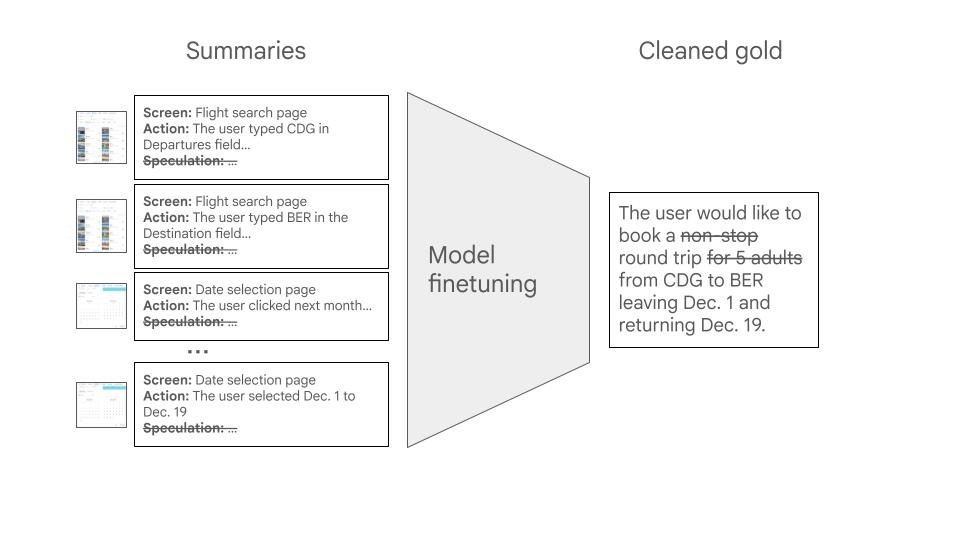
Instead of asking one large model to understand everything at once, Google decomposes the problem into smaller and more reliable steps. According to Google’s findings, this approach consistently outperforms end to end and chain of thought style reasoning on small models.
Reference vs Predicted Intent Comparison
Google also compares ground truth intents with predicted intents.
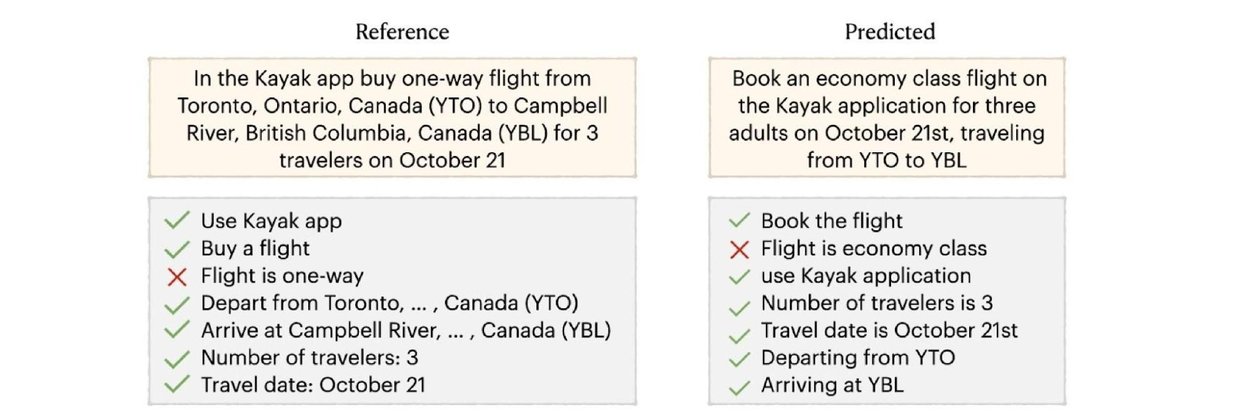
The results show that the decomposed approach captures most factual elements correctly such as the booking platform travel type origin and destination number of travelers and travel dates.
Errors mainly occurred when the model inferred details that were never explicitly shown in the interaction summaries. This reinforces why Google chose to remove speculative intent before final prediction.
Precision and Recall Results
In the recall and precision analysis screenshots, Google highlights two key improvements.
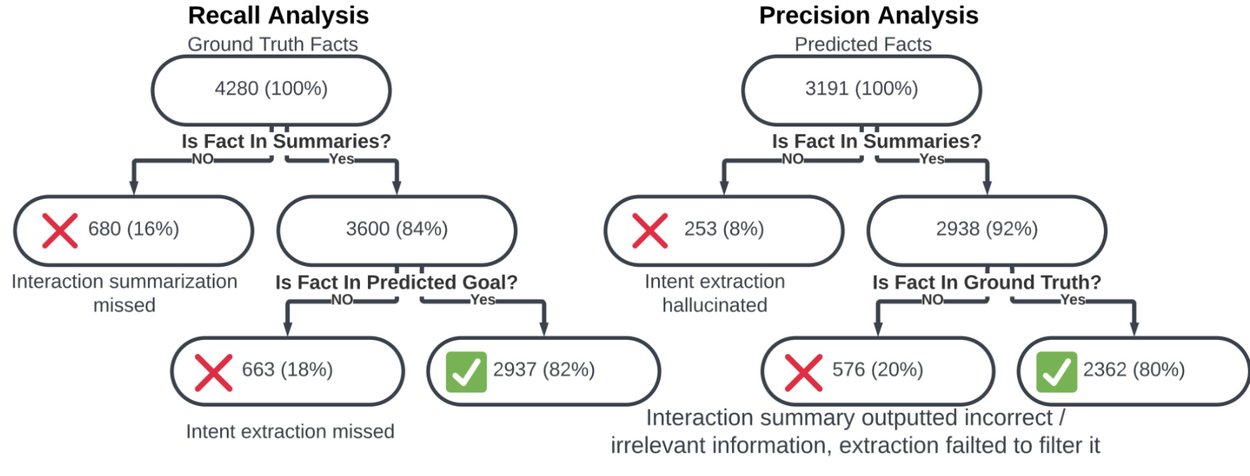
Fewer missed intents compared to end to end models and lower hallucination rates during intent extraction.
The decomposed method achieved higher factual precision by filtering out irrelevant or unsupported information early in the pipeline.
Performance Across Android and Web
The final charts compare performance across Android and web trajectories using different models.
Across both environments the decomposed approach consistently achieved higher BiFact F1 scores. Small on device models performed competitively with and sometimes better than larger centralized models.
Key Insight From Google’s Blog
Google summarizes this research clearly in their official blog post.
By breaking intent extraction into smaller verifiable steps on device models become more reliable more private and more scalable. As device level compute continues to improve Google sees intent understanding as a foundational building block for future assistive and autonomous experiences.
Final Takeaway
This research is not just an academic exercise. It signals a future where intent is inferred from real behavior processed locally and used responsibly.
For marketers SEOs and product teams the implication is clear.
Design journeys that are clear consistent and intent aligned. Because the better your user experience communicates intent through actions the better future AI systems will understand and support your users.